George hates broccoli.
Videos
For those of you who don’t know, I have been working at a raptor center for the last four years, and this is where I learned everything I know about animal training. We use a contemporary, stress-free and force-free method of training that is used by many other professional animal trainers, which follows an “A-B-C” guideline. I’ve gone on to use this method on the lab chickens and turkeys I study as a poultry welfare and behaviour researcher, and I also spend nearly all of my spare time at home training my personal backyard chickens to perform a lot of the same behaviours I’ve trained on other groups like falcons and hawks. This is a very short clip of me training Arty, one of the hens I adopted from my lab to do “hops”, or short, horizontal flights. Here’s how the A-B-C method is broken down:
- Antecedents: This is anything and everything that precedes a behaviour. The most obvious example in here is the double-tap I do on my forearm, which I shaped Arty to respond to in less than a day. Before she learned this “cue”, however, the antecedent was me waving a treat, or reinforcer, above my forearm. Eventually, I was able to incorporate the double-tap, and fade out having the reinforcer in plain view. There are many other different types of antecedents, though, and some may cause a behaviour that you don’t desire/intend to train. For example, any disturbance like a loud noise or a more dominant hen pushing Arty out of the way would have been antecedents for a different behaviour, such as walking or flying away from me. When training an animal, it’s important to be aware of all possible antecedents, and “arrange” them in a way that sets the animal up for success.
- Bridge: This is a signal, such as a click, whistle, “good boy/girl”, etc., that acts as a line of communication with the animal, letting it know that he/she has successfully done the behaviour you asked for, and that a nice treat is coming. Timing is very important here, as you want to make sure that you are reinforcing the specific behaviour that you want, and nothing else. Bridge immediately, but only once the behaviour is completed (e.g. I only click as soon as both Arty’s feet are in contact with my arm or the perch), and deliver the reinforcer as soon as you can afterward. Note: Some facilities/trainers say that the B stands for Behaviour, which is anything that an animal does – whether it’s a desired (flying to the trainer) behaviour, or undesired.
- Consequence: At its simplest, this is what happens after the behaviour. The most successful (and ethical) type of training is through operant conditioning with positive reinforcement. Here, Arty gets rewarded, or positively reinforced, as soon as both feet land on my arm, after I’ve given the cue. Use reinforcers that you know the individual you’re training loves (I literally share my meals with my chickens, but here I’m just using whole-wheat tortilla bits), and the process becomes much easier for both the trainer and the animal, and trust is built up quickly! What are the consequences of “undesired” behaviours, for example, if Arty became startled and took off? This means she gets to avoid and escape from whatever threats she perceives, whether it was the loud noise or punishment from a dominant hen. In any case, it is important for the animal’s welfare that they have the choice to do so. Whether she comes to my arm or not is up to her, and if at any point she decides she is no longer interested, or feels unsafe, she is free to go. This also helps develop trust between the trainer and the animal, and almost guarantees positive sessions.
It honestly hurts me a bit when I see or hear about chicken owners chasing their birds into their coop at the end of the day. This is totally not necessary. All it takes is just a few minutes every day building trust with them. This is usually done with food – again, take the time to figure out which reinforcer works best with each individual. Some of my hens love (whole-wheat) pasta, some don’t, my rooster would inhale blackberries whole, half of the hens don’t care for it at all, and (unfortunately) cuddles/petting don’t work as well with chickens as they do with dogs, parrots, etc., as primary reinforcers. Bridge every time before you present a reinforcer, and you’ll be surprised how quickly they learn to pay attention to it, even when they can’t see any treats. In a pinch, I get my flock to recall (come to me from wherever they are) or follow me around when I click, because they know for sure that I’ll give them the good stuff soon. Ideally, there should be a separate cue for calling them over, then bridging and reinforcing once they’re where you want them to be, but this way still works. I start clicking as soon as I get out of the car after a long day at school/work, and I can’t tell you how wonderful it feels to see them literally fly and run to me from an acre away just to greet me. I haven’t had to chase them anywhere in years, and doing so does not give them a choice and causes fear. This way is so much easier, and entertaining!
Hey ignore my ugly voice but I saw these birds waaaay back in petco and I almost started crying.
I don’t even like birds (scared of them) but I just wanted to go into a room with them and give them the attention they deserve.
For some reason a bird speaking Japanese is mildly off putting.
> Literal translation
Bird:” ‘Uhm Hello, this is the Ono family.”
Bird: “What’s wrong?”
Owner: “Abe-chan, you’re a little too early. Once the phone’s picked up, then properly say hello.”
Bird: “Okay, understood.”
Owner: “Do you really understand? I’m counting on you. Hello, this is the Ono family residence in Gifu.”]
Bird: “Okay, I understand!”
Owner: “Got it.”
> That’s clearly some sort of Pokemon.
> Off-putting? It’s like birds were meant to speak Japanese!
> For some reason it’s never occurred to me that birds can mimic languages other than English. It’s so cool, though!
this is the common hill myna!
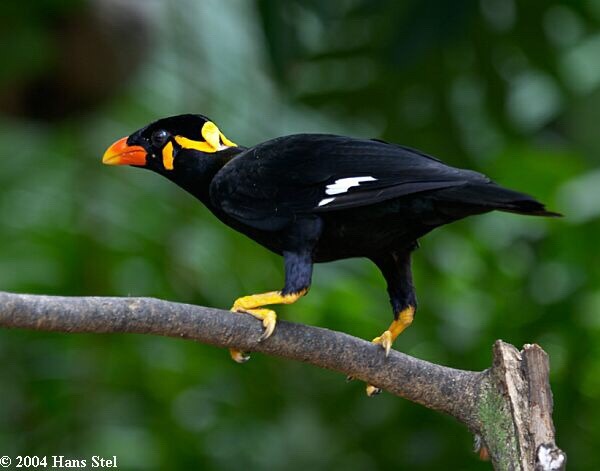
(image from orientalbirdimages.org)
they’re more often just called “myna” or “mynah” in aviculture. there are other myna species which are capable of talking, but this is the most common in aviculture and it’s generally agreed upon that they are the best talkers.
mynas are a part of the starling family, but manage a much better reputation than starlings, which are typically regarded as loud and obnoxious. unfortunately, mynas have come under some pressure from poachers. their loud calls are easily recognizable, so some of them are stolen from the wild for the pet trade, despite new laws making it harder to illegally export wild-caught birds.
I’d just woken up so I look like ass; but this is what Dallon does every morning after I feed everyone and clean their water.
Must give birb scritches.
Happy Sunday, everyone! And, thank you for 1000 followers 🙂 I promised I’d write up a new post for those of you who just started following me, so enjoy this video of one of my black sex-link hens, the Queen, being cute and dust-bathing in the sun.
I think everyone here on birdblr loves to watch their birbs bathe, whether it’s done in water or a nice patch of dirt. Some bird species have no problem bathing in either, but most, if not all gallinaceous birds (poultry, including chickens and quails) will only dustbathe. Why do they do it – how does rolling around in dirt keep you clean?
The most common answer people will give you is that dustbathing keeps ectoparasites – mites and lice – off a chicken’s skin and feathers. While this has been common knowledge among both chicken farmers and backyard chicken owners for decades, you might be surprised to learn that no one ever actually tested this scientifically until 2012. There are possibly hundreds of studies which basically tell us that dry dirt or sand is just like dry shampoo for the birds, absorbing excess oil from their feathers, and removing it once the dust is shaken, or “roused” out. Certain species of avian mites and lice feed primarily on the oil, so it was believed that regularly removing it would leave the parasites without a food source, if the physical movements involved in dustbathing behaviour didn’t dislodge them first. Martin and Mullens were the first researchers to actually test and support the hypothesis that dustbathing behaviour evolved, at least in part, specifically for the purpose of reducing the number of parasites on a bird’s body. Their work also showed that sulfur, which is among one of the many naturally occurring elements in dirt, plays a big role in keeping parasites away by killing them through direct contact and possibly fumigation. So, there is solid evidence that dustbathing helps with parasite control, although no one ever really bothered looking into it, for some reason.
What was more commonly studied was the effect of dustbathing on a chicken’s feathers. By removing all of that excess oil, down feathers in particular become fluffier as a result (side note: this is also one of the few instances where the word “fluffy” is used in a scientific paper). This increases the overall insulation ability of the plumage, and hens housed on an appropriate dustbathing substrate have been shown to have lower temperatures on their backs (important for keeping cool on hot days like today!).
Here’s the not-so-cute, kinda depressing part of this post. We know that dustbathing has all these hygiene-related benefits for the birds. So why are hens kept on commercial egg farms (note: I’m only speaking based on current Canadian poultry industry practices) not given anything to dustbathe on? Generally, commercial birds who never get the chance to go outside don’t become exposed to ectoparasites, which most farmers are only concerned about because they can cause a hen to lay fewer eggs per year. Barring that, it’s argued that there just isn’t any other reason to give hens a chance to dustbathe. That’s where animal welfare researchers come in (and that’s why I love my job). In the last few decades, there have been a plethora of studies showing that hens kept in wire cages will “sham” dustbathe, or perform dustbathing behaviours when there is no dust to begin with. At that point, the behaviour becomes labelled as “abnormal”, indicating that the animal has some need that is not being met. Other studies have demonstrated numerically how much work a hen will put in to dustbathe – for example, some experiments involve hens learning to push through heavy doors (up to a certain percent of their own body weight) just to access a pan of peat to dustbathe in. Finally, a fascinating study done very recently showed that dustbathing quail had a higher tendency of exhibiting possible facial indicators of positive emotions (i.e. dustbathing birb = birb with poofier face = possibly happy birb). With such a large body of solid, scientific evidence to support a significant emotional significance of expressing proper dustbathing behaviour in birds (I don’t know about you, but there are days when a nice bath/shower is more about stress relief and self-care than just keeping clean), researchers have been able to effectively argue for providing dustbathing opportunities to commercial laying hens. In Canada, battery cages will be banned from all egg farms by 2036, and replaced by “enriched housing”, which will be required to include, among other things, a small area for dustbathing behaviour.
So, while it may sound annoying at times when researchers like me say things like “there is/isn’t any scientific evidence for x”, the reason we need to look for that solid evidence is that it’s the only thing that industries and the public will listen to, and often it’s the only thing that can bring about positive (but small) change!
References:
Bertin A, Cornilleau F, Lemarchand J, Boissy A, Leterrier C, Nowak R, Calandreau L, Blache MC, Boivin X, Arnould C, Lansade L. Are there facial indicators of positive emotions in birds? A first exploration in Japanese quail. Behavioural processes. 2018 Jun 30.
Martin CD, Mullens BA. Housing and dustbathing effects on northern fowl mites (Ornithonyssus sylviarum) and chicken body lice (Menacanthus stramineus) on hens. Medical and veterinary entomology. 2012 Sep;26(3):323-33.
Van Liere DW, Bokma S. Short-term feather maintenance as a function of dust-bathing in laying hens. Applied Animal Behaviour Science. 1987 Aug 1;18(2):197-204.
Wichman A, Keeling LJ. Hens are motivated to dustbathe in peat irrespective of being reared with or without a suitable dustbathing substrate. Animal behaviour. 2008 Apr 1;75(4):1525-33.
 today's bird