My little Barn Owl necklaces are now back in stock


barn owl best owl
I love how the barn owls are literally making (◕ヮ◕) faces
helP ME


npr:
This flightless bird was clumsy on land, but a powerful predator in the sea. Its eggs resembled marble and its bones were of significance to Native American cultures in North America. Armed with a giant bill, it was thought to have mated for life, but a comprehensive scientific observation of this creature is lacking. That’s because the animal went extinct in the mid-nineteenth century. Today, enjoy a few facts about the great auk (Pinguinus impennis).
- As the BBC notes, “the irony is that once they became extinct, Great Auks became even more sought after.” Today, there are only around 80 skins of great auk remaining. They’re mostly in museums, like the above specimen, which was photographed in Scotland.
- The largest known breeding colony was on Funk island, east of Newfoundland. As the Cornell Lab of Ornithology notes, “the Great Auk was the last flightless seabird of the Northern Hemisphere. It also had breeding colonies in the Gulf of St. Lawrence and off the coast of Scotland and Iceland.
- The birds ate fish (including Atlantic menhaden). Adults were excellent swimmers, able to hold its breath for extended periods of time and make shallow dives to forage. Younger auks ate plankton. The birds are believed to have lived for about 20 to 25 years in the wild.
- The IUCN Red List of Threatened Species points out the Great Auk was driven to extinction “by hunting for its feathers, meat, fat and oil.” In fact, the bones of Great Auks have been found by Neanderthal campfires and its image has appeared in carvings and paintings dating back tens of thousands of years.
(Image Credits: Wikimedia Commons / Source: IUCN Red List of Threatened Species;The Cornell Lab of Ornithology: Birds of North America; Wikimedia Commons; BBC Radio 4: Natural Histories; Popular Science Monthly, Volume 33, August 1888, The Home of the Great Auk)
Impress your family with facts about this extinct bird! -Emily


These little bunnies, about 6 days old, were attacked by a dog and orphaned. Two out of the litter of five did not survive, and these three were not doing very well.
Enter Noah-the non-releasable, one-legged homing pigeon/rock dove that we have here in rehab.
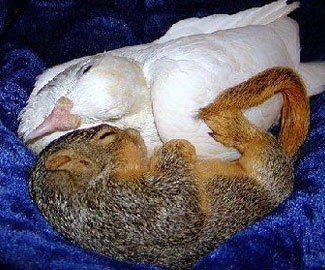
Noah kept going over to the bunny cage and looking in-even sleeping in front of the door to the cage. Then, 2 days ago, I only counted 2 bunnies in the cage, so I hurriedly picked Noah up from the front of the cage so I could look inside. And to my surprise-there was the tiny bunny-under Noah’s wing-sound asleep!
The bunny had crawled through the cage-preferring a featherbed, no doubt. Now, they are all together, and the bunnies are doing GREAT. When the bunnies scoot underneath Noah’s feathers, he extends his wings out to surround them-and they snuggle. When one of them moves and they start sticking out here and there, he gently pushes them back under him with his beak!
Although the bunnies seem to be his favorite, Noah now helps out with many rescue babies here at the Wild Rose Rescue Ranch.
How wonderful it is to have a full-time soft-feathered nurturer here at the rescue ranch! He cuddles with all the babies as they snuggle under his warm feathers…and he “coos” as if singing them to sleep with a lullaby.


Where will you go? – Somewhere I can live in peace with my friends. Don’t you see? I have a
mission to help pigeons everywhere. Wherever there’s a bird in need of
seed, I’ll be there. Wherever there’s a helpless flock suffering some
abuse, I’ll be there. Wherever there’s a pigeon with a weak wing or a
broken beak, I’ll be there.


INKTOBER 2017!! I’ve been excited for it all year. The theme this year are birds and flowers. I picked out a bunch of birds to draw, and researched flowers native or common to where the birds are native/common to. I ended up pairing up a lot of state/national birds with state/national flowers. (The only time I didn’t do it was for Day 1, that was a on a whim thing)
REMEMBER! I update my Inktober daily on my twitter!
WEEK 1
Day 1: Blue Tit – Cherry Blossoms
Day 2: Resplendent Quetzal – Monja Blanca
Day 3: Light Brahma Chicken – Rose
Day 4: Inca Tern – Cantuta
Day 5: Harpy Eagle – Poppy
Day 6: Kiwi – New Zealand Daisy
Day 7: Potoo – Sacuanjoche


 today's bird