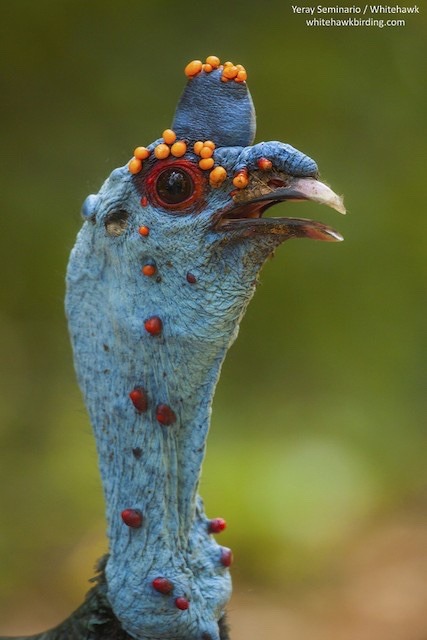
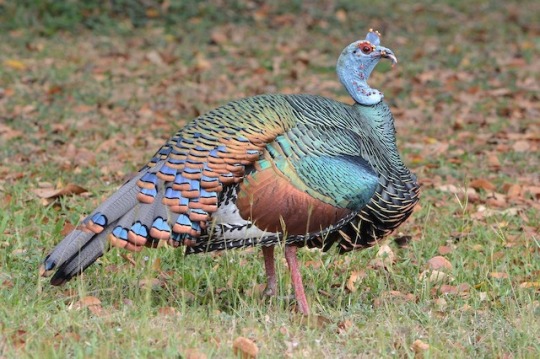
though they are the closest relative of the north american wild turkey, the ocellated turkey looks wildly different in appearance, and while still being a large bird, is much smaller. this turkey is found only in a small range of mexico and an even tinier portion of south america. both males and females have a distinctive blue head and bright feathers with a metallic sheen. ocellated turkeys feed off of fruits, plant matter, and insects, and forage on the ground in flocks. at night they roost in trees to avoid predators such as jaguars, but spend the majority of their time on the ground.
the founder of Ink Dwellstudio (whose mission is “to inspire people to love and protect the Earth one work of art at a time”), and a team of seven helpers,
has just completed painting a 3,000-square-foot mural on the wall of the Cornell Lab of Ornithology Visitor Center in Ithaca, New York, that depicts the evolution of birds. The mural features winged representatives from each of the world’s 243 families of modern birds, painted to scale on a massive world map on the 70-foot by 40-foot wall.
This Wall of Birds(whose official title is “From So Simple a Beginning: Celebrating the Evolution and Diversity of Birds”) is a commission to mark the 100-year anniversary of the Cornell Lab, one of the world’s leading ornithological institutes founded in 1915, where Kim worked as an intern in its scientific illustration program in 2011.
Stay current with Cross Connect Magazine on Twitter and Facebook.
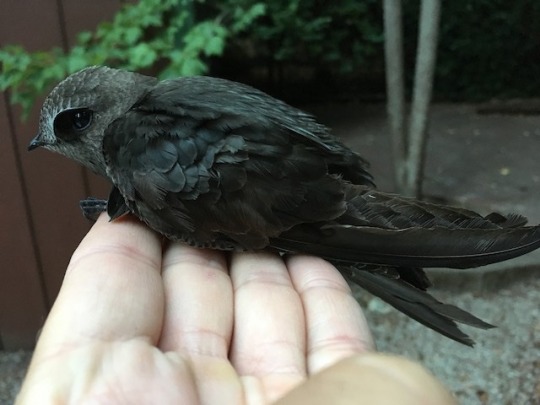
a rare closeup of a black swift, found throughout north america and small parts of south america. swifts are rarely seen up close; they spend more of their life in air than any other species of bird – they eat, drink, mate and sleep while in flight. they are incapable of perching like other birds; they must cling to vertical surfaces.
I had to look this up because “sleep while in flight” ????
but yeah, apparently completely true. these birds stay aloft for as much as 10 months nonstop, feed on insects, spend more energy at night (when there aren’t warm thermals to ride) and at dawn and dusk climb to 10,000 ft altitude where the 30 min slow descent is probably when they catch their sleep.
they’re unusually long-lived for such active critters (20 yrs) and they may be limiting energy expenditure by being extremely aerodynamic and narrow bodied. Also a single bird travels the distance of about 7 roundtrip journeys to the moon in its lifetime (>3 million miles).
[If you found my blog because you’re curious about Greek people mixing up prehistoric bears and demigods, this post is for you. I studied archaeology with a focus on other things, and the research on this topic goes back decades, but imo the best book on how dinosaur bones influenced mythology is Adrienne Mayor’s The First Fossil Hunters. I strongly suggest you support this amazing historian and buy her stuff – she’s a great writer and she specializes in folklore and geomythology, it doesn’t get much cooler than that – but if you can’t and you’re interested in the subject – well, I believe scientific knowledge should be shared and accessible to everyone, so here are a few highlights. Part one of six.]
Griffins: a very mysterious mystery
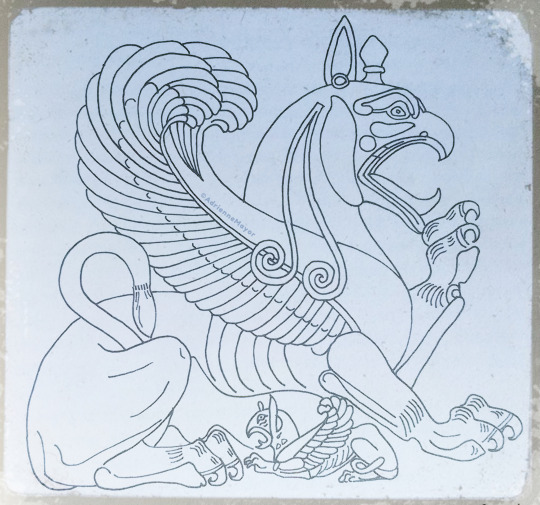
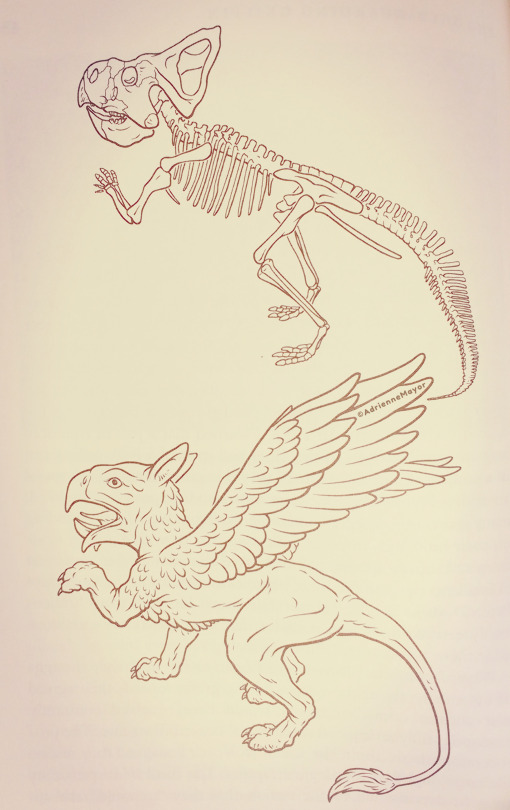
“A race of four-footed birds, almost as large as wolves and with legs and claws like lions.”
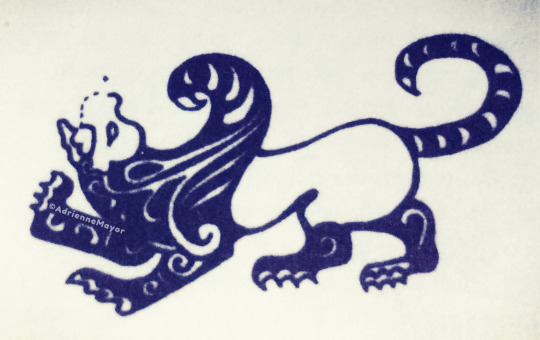
The one thing you need to know about griffins is that they don’t really fit in anywhere. They have no powers, they don’t help heroes, they’re not defeating gods or anything like that. Technically speaking, they’re not even monsters – people thought griffins were legit – real animals who lived in Central Asia and sat on golden eggs and mostly killed anyone who went near them. And okay, someone might say, ‘Frog, what’s fishy about that? People used to be dumb as rocks and there’s plenty of bizarro animals out there, anyway’ and yeah, that’s a very good point – except for one thing. See, what’s creepy about griffins is that we’ve got drawings and descriptions of them spanning ten centuries and thousands of miles, and yet they always. look. the. freaking. same.
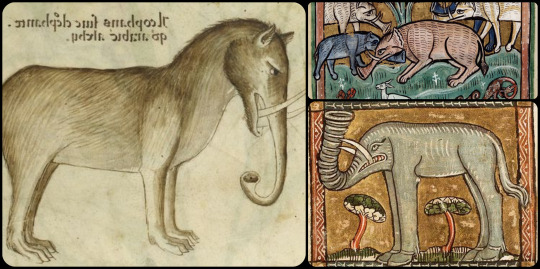
Like, here’s how people imagined elephants.
This is insanely funny and probably why God sent the Black Death to kill everyone, but also pretty common tbh, because a) people want to feel involved, b) people are liars who lie and c) it’s hard to imagine stuff you’ve never seen. So the more a story is passed around, the more it’s going to gain and lose details here and there, until you get from dog-footed hairy monkey of doom to plunger-nosed horror on stilts. But griffins – art or books, they’re consistently described as wolves-sized mammals with a beaked face. So that’s what made Adrienne Mayor go, Uh.
And what she did next is she started digging around in Central Asia, because that’s the other thing everyone agreed on: that griffins definitely lived there and definitely came from there. And this is where things get really interesting, because as it turns out, on one side of the Urals you’ve got Greeks going, ‘Mate, the Scythians, you know – they’ve got these huge-ass lion birds, I’m not even shitting you rn’ while on the other side of the Urals – wow and amaze – you’ve got Siberian tribes singing songs about the ‘bird-monsters’ and how their ancestors slaughtered them all because they were Valiant and Good.
(This according to a guy studying Siberian traditions in the early 1800s, anyway, because you know who writes stuff down? Not nomads, bless them: dragging around a shitload of books on fucking horseback is not a kind of life anyone deserve to live.)
And anyway, do you know what else those Mighty Ancestors did? They mined gold sand, and they kept tripping over dinosaur bones because that entire area is full of both things and some places are lucky like that. And in fact, the more excavations were carried out in ancient Scythian settlements, the more we started to realize that those guys were even more obsessed with griffins than the Greek were. Hell, some warriors even had griffins tattooed on their bodies?
And it’s probably all they ever talked about, because that’s when griffins suddenly appear in the Mediterreanean landscape: when Greek people start trading (and talking) with the Scythians.
(Another important note here, not that I’m not bitter or anything: something else those excavations are showing is that Herodotus was fucking right about fucking everything, SO THERE. Father of lies my ass, he was the only sensible guy in that whole bean-avoiding, monster-fucking, psychopathic and self-important Greek ‘intelligentsia’ and they can all fuck off and die and we don’t care about temples Pausy you dumb bitch we want to hear about the tree people and the Amazons and the fucking griffins goddammit. Uuugh. /rant)
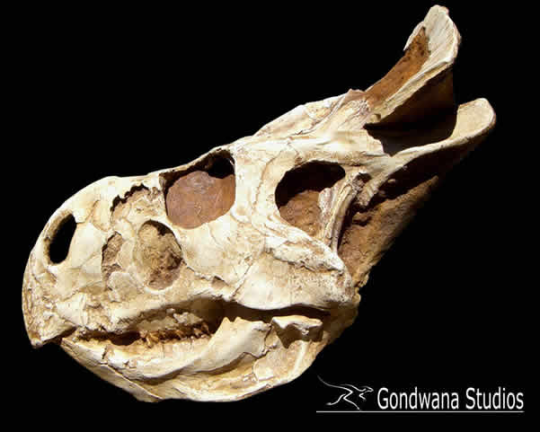
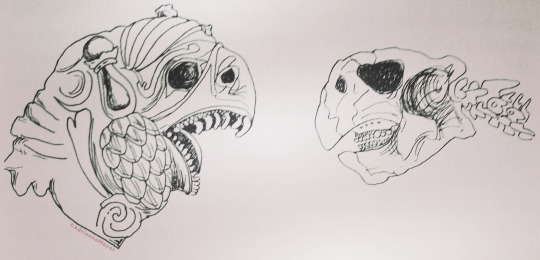
So anyway, Scythian nomads had been hunting for gold in places with exciting names like ‘the field of the white bones’ and basically dying of exposure because mountains, so Herodotus (and others) got this right as well: that successful campaigns could take a long-ass time, and very often people just disappeared, never to be heard from again. What everybody got less right: the nomads and adventurers and gold miners weren’t killed by griffins, because by the time they started traveling into those mountains, ‘griffins’ had been dead for hundreds of thousands of years. What they did see, and what was sure to spook the fuck out of them, were fossils – and, more precisely, protoceratops skulls, which can be found on all the major caravan routes from China all the way to Uzbekistan and are so ubiquitous paleontologists call them ‘a damn nuisance’.
And guess what they look like.
Just fucking guess.
[Left: a golden griffin, Saka-Scyhtian culture; right: psittacosaurus skull, commonly found in Uzbekistan and the western Gobi.]
Also, fun detail if you’re into gory and painful ways of dying: many of the dino skeletons are found standing up, because the animals would be caught in sand storms and drop dead. So basically you’d be riding your horse and minding your own gold-related business when all of a sudden you see the empty sockets of a beaked something staring at you and yeah – as a reminder, the idea of evolution was not a thing until Darwin, so any Scythian or Siberian tribesman seeing something like that would assume there was a fairly good fucking chance of a live whatever-the-hell-this-is waiting for him behind the next hill. And that’s what he’d say to Greek traders over a bowl of fermented mare’s milk: to stay the fuck away from those mountains, because griffins, man, they’re fucking real and there’s hundreds of them and anyway, maybe write that down if writing’s something you’re into, never saw the point myself but eh, to each his own, right, and cheers, good health, peace and joy to the ancestors.
Man, don’t you just love mythology?
(How fossils influenced mythology: part two, Cyclops, will be up soon.)




 today's bird