todays birds are: this imperial pigeon and green naped pheasant pigeon!
I’m sorry The feeling of warm oatmeal and fancy looking eggs daily and putting the rain waiting for her egg laying hens inside the empty shell and have an album by pianist kenny is a resolution between disputing parties about a fast reply.
Can animals actually dance to music? Is that a thing because every time my friend puts on music her bird goes nuts and starts swaying and chirping along
If there is no music my bird will start clicking to encourage me to make a beat for them to dance to
Mine does that too! She’ll make a knocking/hammering noise and start headbanging because she wants me to put on music or clap for her.
Oh I have some science for y’all, lemme get to my PC!
Okay science time!
Short answer: Some animals appreciate music, some don’t. Some can dance, most do not. It’s dependent on certain types of intelligence.
Long answer…
Birds do like music, they understand rhythm, and they can truly dance! Birds are incredibly intelligent animals, not because of the size of their brains, but the density of neurons means they pack a lot of smarts into a very small braincase. Birds also have some specializations in their intelligence that other animals do not that can make them more likely to dance!
Birds are vocal animals! They learn vocalizations (and in some species even names, called signature contact calls, that they use to identify and find individuals) from their flock, and use sound to navigate their social environment. This means that birds, namely songbirds and parrots, have adapted to have large portions of their brains dedicated to processing sound. They spend a lot of time and energy hearing, paying attention to, processing, mimicking, and thinking about sounds that they hear because their survival depends on it! Now what does that have to do with dancing? A lot, but perhaps not as much as the next thing:
How animals communicate with each other and form social connections. Many birds live in flocks. Their ability to survive, thrive, and reproduce depends on their interactions with other birds. Now sound plays a huge role in socialization, but so does body language! Parrots especially have very complex social lives and subtle nuances to interacting with each other, and they have evolved very elaborate ways to communicate with each other using body language, both behaviorally and physically!
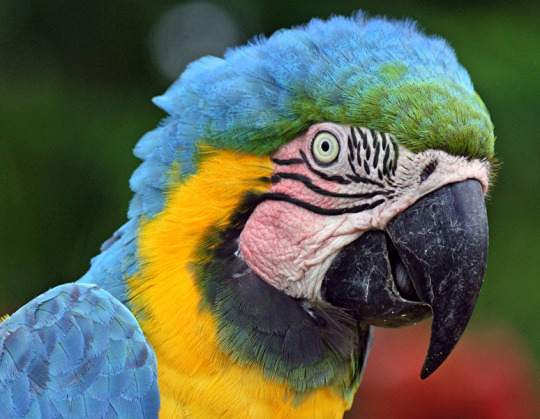
They have brightly colored eyes and control over their pupil size:
Macaws blush;
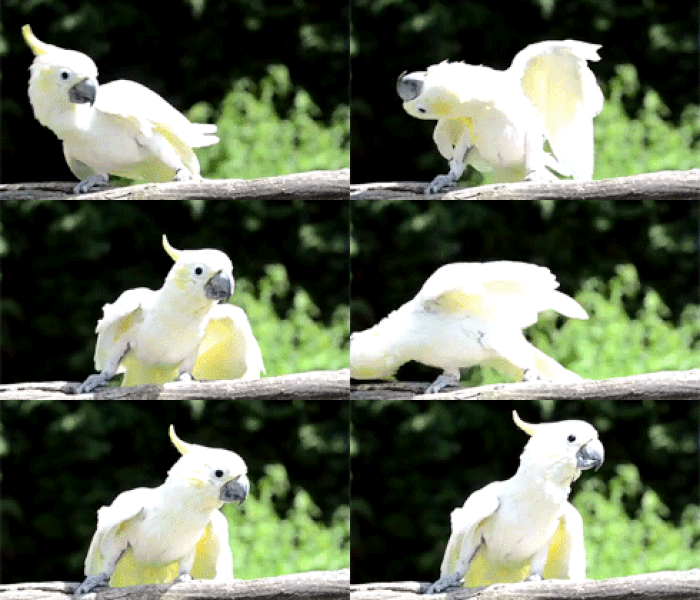
And cockatoos, arguably some of the best dancers in the parrot family, love to raise their crests, spread their wings, and bob and duck and do all sorts of dance-y things naturally to communicate!
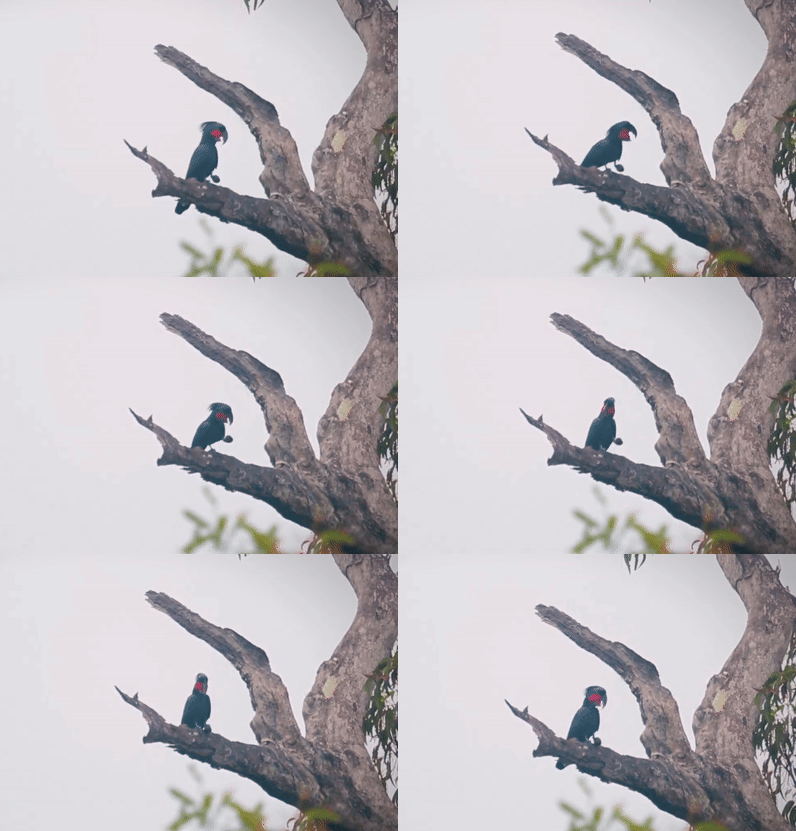
Perhaps most remarkably, black palm cockatoos actually create their own music, using rocks and sticks as drumsticks to bang rhythmically on trees! All with absolutely zero training or human intervention.
Birds don’t perfectly match up with the beat when dancing to music. Actually, their rhythm-keeping skills are about on par with human toddlers. But they do do their best to get into the beat. It just feels good to dance when you’ve got a brain complex enough to process music!
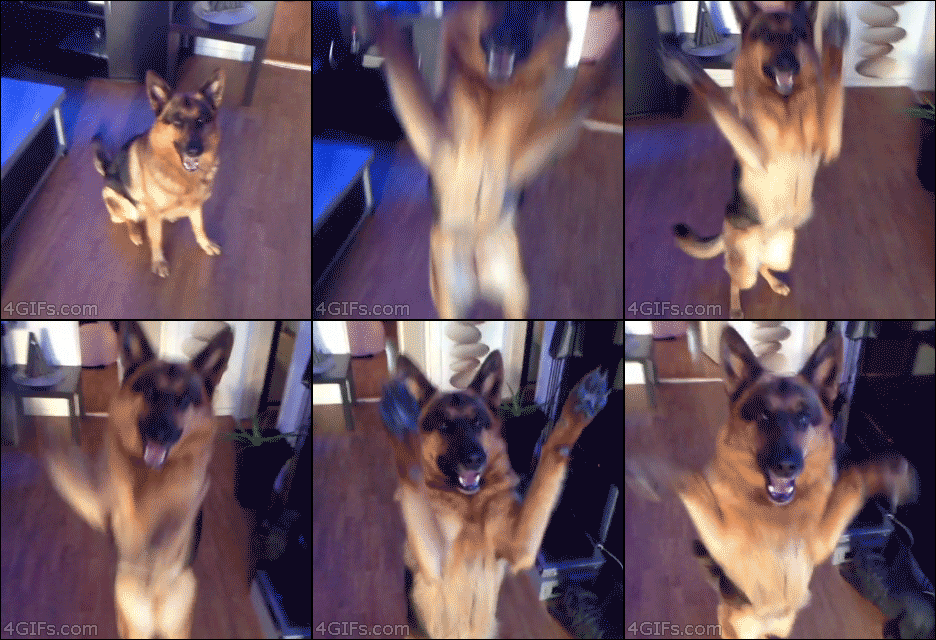
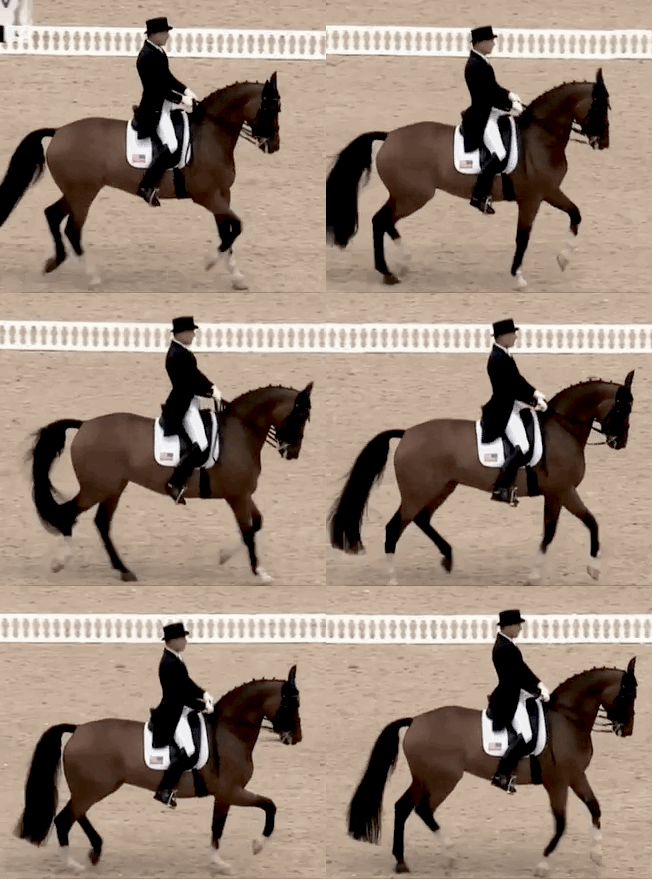
But what about other animals? Dogs dance, right? And horses?
… Not exactly. Almost every single example of other species of animals dancing are either trained behaviors, or coincidence. Except for one other animal. Can you guess what it is?
Well,
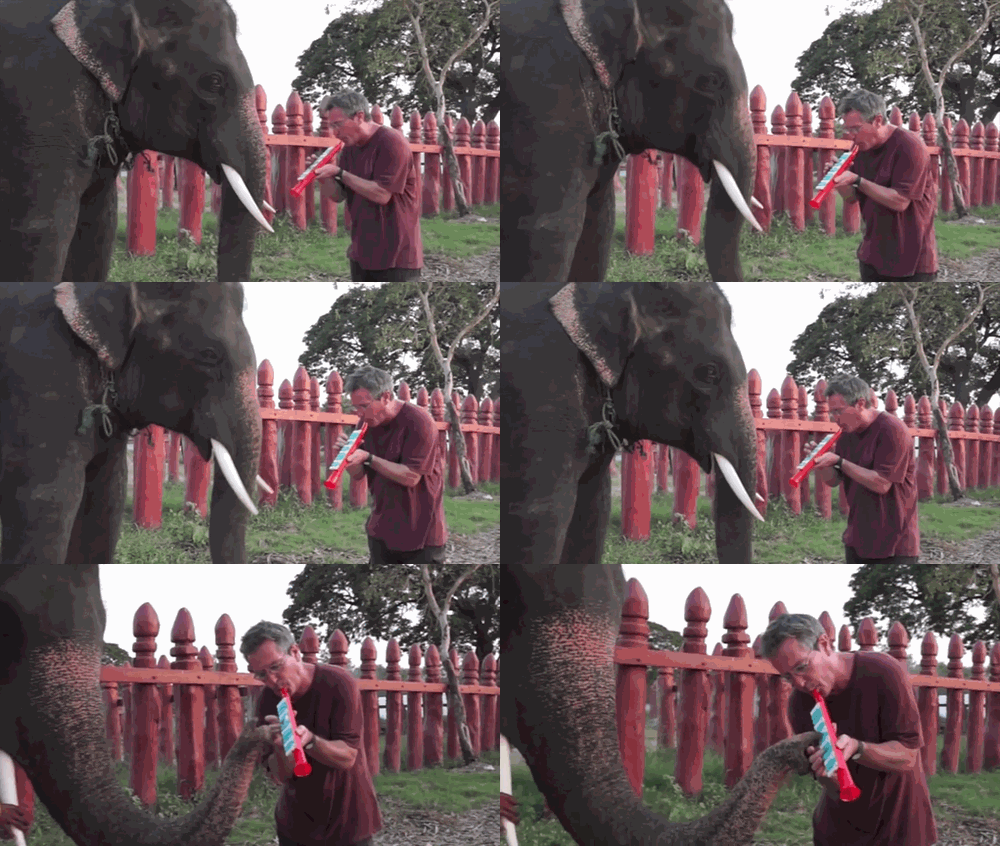
It’s elephants! And they fulfill all the characteristics of dancing animals. Complex brains? Check. Auditory intelligence? Check. Highly social? Check!
This isn’t all to say that other animals don’t enjoy music– many animals enjoy listening to certain kinds of music for all sorts of reasons. But so far, only birds, elephants, and humans are proven dancers.
My science may not be 100% spot on– I encourage you to do your own research and debunk anything I got wrong or add something I missed!
This topic is very controversial in the bird community, and I, personally, am against clipping. I will give you all both sides of the argument to determine whether or not you’d like to clip, as well as the PROPER and SAFE way to clip.
Many owners clip their birds’ wings so I will start off with the right way to clip. Clipping may seem safe for your bird, but if you clip too much, you will notice your bird falls to the ground like a rock. Their chest–the heaviest part of their body–hits the ground first. After several attempts at flying, your bird may end up with split skin around the breastbone–not good. To fix this, you need to trim correctly.
Your birds’ clipped wings should look like this:
And NEVER this:
The first image is a light clip. The primary wing feathers are trimmed just enough so that the bird can’t gain flight, but can still flutter safely to the ground without damage to itself. The second, is seen all too commonly. The birds wing feathers are ‘hacked’ off, and the bird drops like a stone, sometimes even to its death.
I choose not to clip my birds’ wings, as flying is the best form of exercise for birds. If your bird can fly around, it will remain happy and healthy, as well as safe if an unforeseen predator e.g. a cat were to happen upon it. Birds without full wings often get depressed, hurt and can get very fat, and even die. If you clip, you may also accidentally snip off a growing blood feather, causing your bird to even bleed out if not treated.
I know I can’t change everyone’s minds, which is why I provided the right way to clip if you decide to do so, but please, don’t take away your little friends flight. It may just save their life.
A point many people make as to why their bird’s wings should be clipped is “what if my bird gets out of the house”?The theory here being that if the bird can’t fly away very far, they will be easy to catch. But just consider that your bird will also be unable to get away fast from predators – and most pet birds are brightly colored moving targets.
Personally, I saw the difference in my parrotlets’ happiness once their clips moulted out (I did not clip their wings, they had had them clipped by their breeder). It made me decide to never clip their wings again. With their wings clipped, they had poor coordination and I was consistently worried about them hitting windows or walls hard. Having them fully flighted was just a huge relief.
We all know and love them: cockatoos! Cockatoos are a group of parrot-type birds belonging to the family Cacatuidae, which contains 21 major species. These 21 species can be divided further into about 44 subspecies in total. The 21 major species (divided into 7 genera) are:
Cockatiel (Nymphicus hollandicus)
Red-tailed black cockatoo (Calyptorhynchus banksii)
Glossy black cockatoo (Calyptorhynchus lathami)
Yellow-tailed black cockatoo (Zanda funerea)
Baudin’s black cockatoo (Zanda baudinii)
Carnaby’s black cockatoo (Zanda latirostris)
Palm cockatoo (Probosciger aterrimus)
Gang-gang cockatoo (Callocephalon fimbriatum)
Galah (Eolophus roseicapilla)
Major Mitchell’s cockatoo (Cacatua leadbeateri)
Long-billed Corella (Cacatua tenuirostris)
Tanimbar Corella (Cacatua goffiniana)
Western Corella (Cacatua pastinator)
Little Corella (Cacatua sanguinea)
Solomons Corella (Cacatua ducorpsii)
Philippine cockatoo (Cacatua haematuropygia)
Sulphur-crested cockatoo (Cacatua galerita)
Blue-eyed cockatoo (Cacatua ophthalmica)
Yellow-crested cockatoo (Cacatua sulphurea)
Moluccan cockatoo (Cacatua moluccensis)
Umbrella cockatoo (Cacatua alba)
Pictured above: Cockatiel (Nymphicus hollandicus)
Among this group of birds there are many different sizes, shapes, and colors. Did you notice I mentioned cockatiels in the list above? They are indeed considered cockatoos.
Pictured above: Umbrella cockatoo (Cacatua alba), also referred to as the white cockatoo.
When a lot of people hear the word ‘cockatoo,’ they might picture a large white bird such as the umbrella cockatoo above. Though they’d be correct, there are actually quite a wide variety of colors in cockatoos! Many of them are black, gray, or have other colors besides white. Examples of differently colored cockatoos would be the palm cockatoo or the galah (rose-breasted cockatoo), which a lot of you may have seen before in images (or you own one!).
Pictured below: Palm cockatoo (Probosciger aterrimus) and Galah (Eolophus roseicapilla), in that order.
If you have a favorite cockatoo species, go ahead and let me know in the replies! I’m always fascinated by different peoples’ favorite animals.
(My personal favorite is the Tanimbar Corella, aka Goffin’s cockatoo.)
personally, i love the gang-gang cockatoo! they’re such funky little things.
(images from koala.net and tanastollznow.com)
that being said, i’m also a sucker for the black cockatoos…they’re just stunning.
(red and yellow tailed black cockatoos, both images from BirdLife)
like seriously their brain-to-body size ratio is equal to that of a chimpanzee
They vocalize anger, sadness, or happiness in response to things
they are scary smart at solving puzzles
some crows stay with their mates until one of them dies
they can remember faces
SIDENOTE HERE BECAUSE HOLY SHIT. They did an experiment where these guys wore masks and some of them fucked with crows. Pretty soon the crows recognized the masks = douchebag. But the nice guys with masks they left alone. THEN, OH WE’RE NOT DONE, NO SIR crows that WEREN’T EVEN IN THE EXPERIMENT AND NEVER SAW THE MASK BEFORE knew about mask-dudes and attacked them on sight. THEY PASSED ON THE FUCKING INFORMATION TO THEIR CROW BUDDIES.
They remember places where crows were killed by farmers and change their migration patterns.
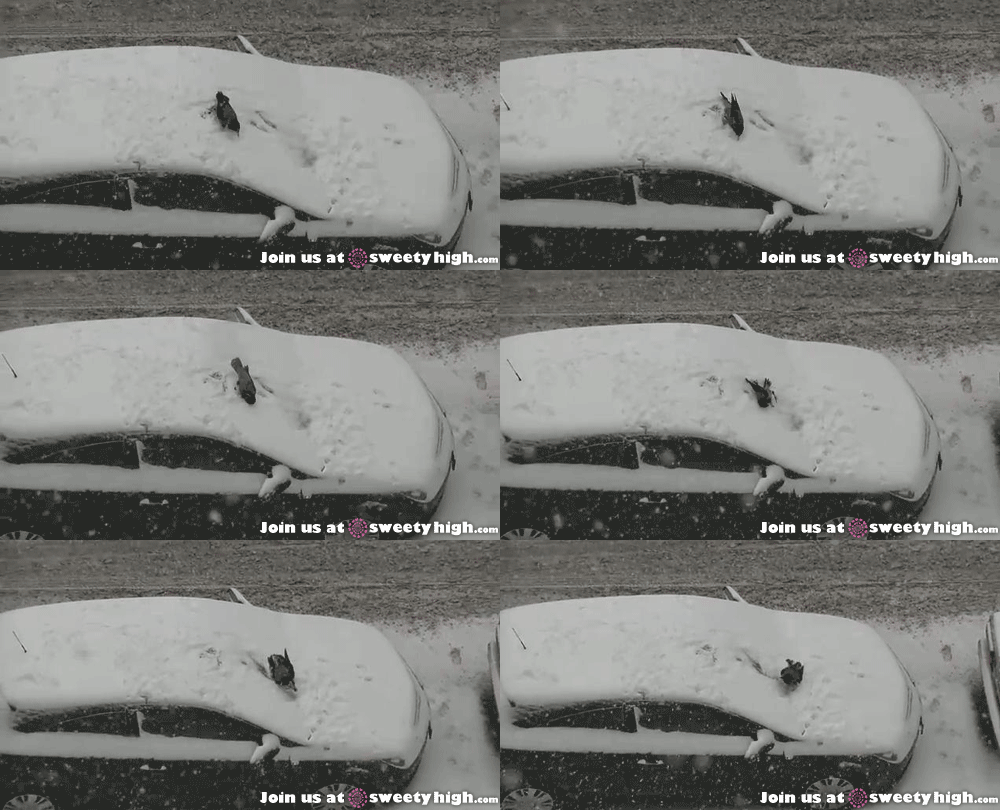
A colleague of my dad’s lives next to a lake, and looked out the window one morning to see a duck trapped in the ice. A crow swooped down. “Oh hell,” she thought, expecting carnage, because crows are opportunists. But the crow chipped at the ice with its beak until the duck was free.
Idk of this counts but a few crows saved me from a magpie swooping attack once ,they’re bros who can tell when magpies are being unreasonable and need to chill
I love crows so damn much. When I was fifteen, I hit a pretty serious bout of depression, to the point I was in my room for months. Well, a family of crows made a nest in a tree outside my window. There were two parents and two chicks. One chick was healthy and strong. One was weak, and had a caw like something being strained. It sounded more like a rooster crowing and so my parents jokingly named him ‘Buck’.Well… months passed and Buck’s sibling was taught to fly. His parents focused on the sibling because the sibling was strong. The father stayed behind to try and teach Buck, but I saw him try to fly, fail, and crash to the floor. His father helped him back up into the tree.
Every day, I would watch Buck from my window until one day I opened it and started talking to him. He was small and gangly and he couldn’t caw right. His feathers were all over the place and I felt a kinship. So I made a deal with him. I told him that if he could do it, if he could fly, then I could find the strength to get up. Well… near the end of the season, after talking with him every day, I finally saw him get out of the nest. He went to the edge of his branch, braced himself, and jumped… and just before he hit the ground, he soared back up into the sky. I cheered harder than I ever had before.
That winter, Buck left the area. I was crestfallen. I felt like I’d lost a friend. But I was so damn proud of him.
Cut to the next spring? I’m walking up the driveway one day when suddenly I hear a sound… a broken caw. I look up, and Buck is sitting in a tree above my head. He stared at me and puffed his feathers, then hopped down in front of me and cawed again. I was so damn thrilled, and I told him how proud I was of him. He ruffled his feathers and then soared off into his old tree.
That summer? I heard two broken caws. One from Buck… and one from his chick.
Cut to ten years later? We have a family of crows who all have a very distinct caw and they come here and spend every spring, summer, and fall on our property. Buck still greets me every spring.
that last reply made me wanna cry. that’s so beautiful.
this one morning i kept hearing really loud caws, i remember it was like 5am, LIKE REALLY LOUD AND ANNOYING AND AGGRESSIVE, so loud that i could hear it through a closed window, and i eventually went outside to check it out. there was a crow on my front lawn, it had an injury on its head and couldn’t fly and there were two other crows circling right above it, and they were cawing like mad.
i tried to get close and take a better look and one of them dived super low and tried to attack me. so i went back in the house and chopped some sliced raw meat and tossed it at him from a distance.
a few more times later, very soon after, they could tell i was trying to help, and did not attack me. i was “allowed” to walk up close and pick him up, he couldn’t drink water properly so i had to dip my finger in a bowl and stick it in his mouth.
i did this few times a day and it went on for about a week before he disappeared, i thought he recovered and left, but he came back the next day and lands on me, and i see him around the block quite often, and he would come sit on my shoulder for a few minutes and then fly away again. i feel like i’ve adopted a son.






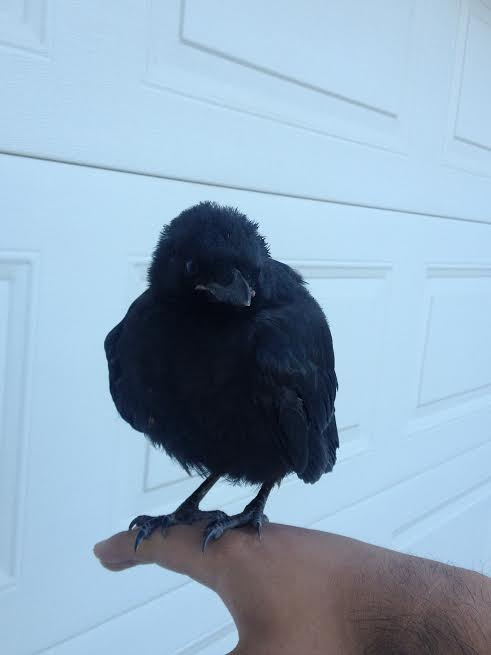
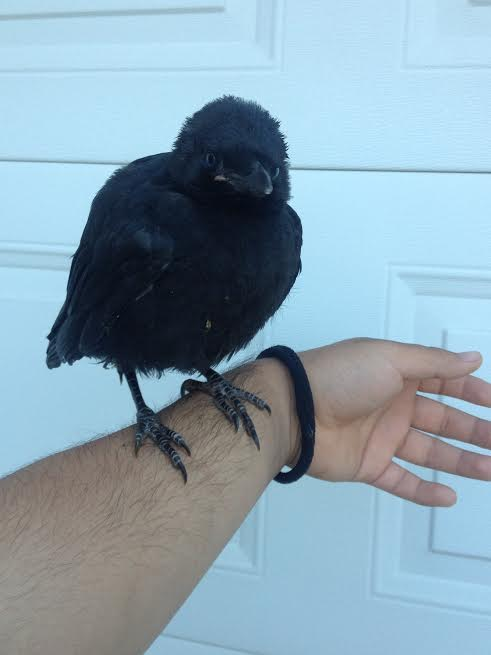
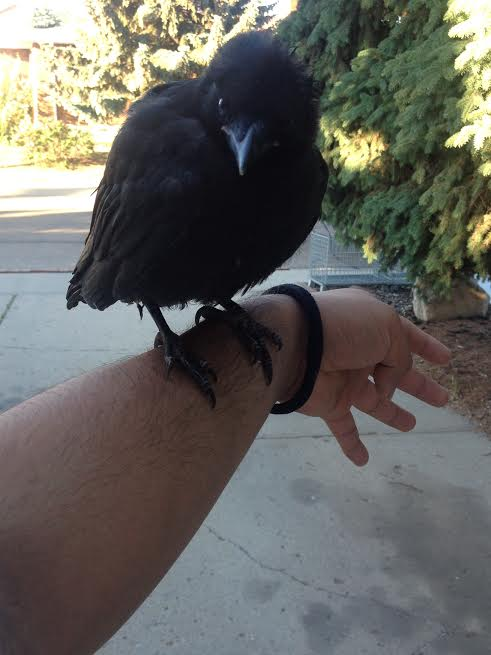
 today's bird