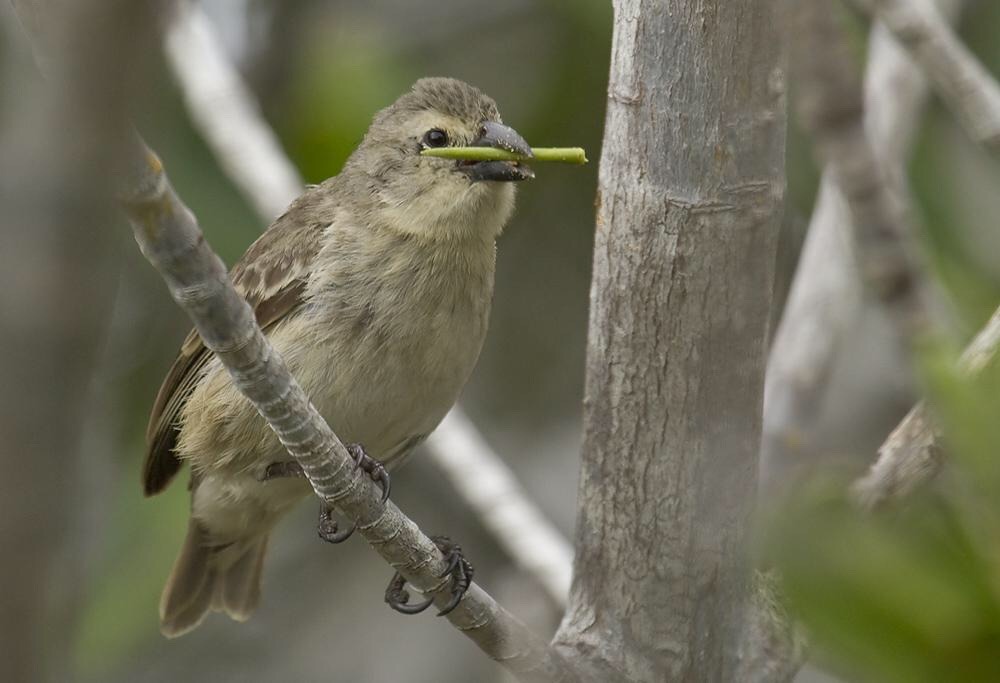
the woodpecker finch, a small finch native to the galapagos islands, is one of few non-corvid or psittacine bird species known to use tools. the finches use tools in up to 50% of their foraging, using sticks or cactus spines to access grubs and insects.
I was asked the other week if I think the birds I work with “know” who I am and can distinguish me from other humans. Personally, I can tell that the hens and turkeys I train at the research laboratory, the raptors I work with in the evenings, and my own pet chickens behave towards me in a way that’s different from how they react to other human beings, suggesting that they do recognize me as an individual. But, as a someone working in behavioural research and running a science-based blog, of course I’m not going to leave you all with nothing but personal anecdotes!
Hypothetically, chickens (and other birds that live in complex social groups) are capable of telling the difference between human faces, at the very least. We can make this assumption based on the fact that 1) individuals living in societies with selective/affiliative relationships/hierarchies (as chickens most certainly do) have to be able to differentiate between each other and remember each others’ features (eye position, beak length, feather colour/pattern, movement/behaviour pattern, vocalizations, etc.) to survive (I’ve previously touched on this here). If no one recognize anyone and keep track of who’s above and below who, there would be total chaos! 2), Pigeons have been trained to discriminate not only between different people’s faces, but between different genders and emotions as well (Watanabe and Masuda, 2010). There are no official scientific reports of similar tests being done with chickens that I could find, but based on their behavioural biology, and the things that I’ve personally trained chickens to do for my research, I’m confident that they’d be more than capable of it, too.
So, while it’s more than likely that chickens can discriminate between different human faces, this does not strictly mean they recognize their subject as individuals, per se. Individual recognition requires that the bird can recognize someone as a whole, and not just a forward-facing portrait of that person, as most recognition experiments do (Tibbetts and Dale, 2007). The bird has to be capable of forming a mental image of an individual from any angle, and also be able to use other identifying features other than the face, such as the person’s mannerisms and voice, like I mentioned above. Apparently, pigeons have difficulty with this. And again, there’s nothing in the literature for it using chickens as a subject. But, I think any backyard poultry owner who’s experienced the joy of their birds eagerly running over for treats or cuddles while ignoring other humans would strongly agree that they recognize their owner (and have positively associated them with food and maybe even affection, no less!), especially if you hatch your own chicks and have them imprint on you.
(Gyrfalcon photo by me, please ask before re-posting)
On a side note, let’s consider non-social birds, like raptors. Most raptors, with a few exceptions, live solitary lives in the wild outside of breeding season. They don’t live in large groups, and don’t have to deal with pecking orders. At the very least, they might have to remember if they’ve had to chase away the same intruder from their territory before, or if they chose the same partner to mate with the previous year. When I’m doing shows/presentations with my raptors, people frequently also ask me if the bird I’m holding “knows” me. I respond by saying that it’s more likely that things are the other way around – I know the bird very well. I know how to approach and handle the bird in the ways that make them feel most comfortable, I know what the possible stressors are in its environment that sets them off that I have to work to avoid, and all of their other quirks. All of this knowledge/understanding of the bird helps me give them as positive an interaction with me as possible during every training session, resulting in them being more comfortable with me, as opposed to a novice trainer/someone who has never worked with that specific bird before. This may also partly factor into why chickens behave differently in response to certain owners, compared to other humans they encounter. For example, a big part of the reason that my chickens seem to always want to be near me (other than the fact that I’m basically a constant source of treats), but avoid my parents, probably has to do with the fact that I specifically know how to walk up to/pet/feed them without accidentally startling or intimidating them.
As another side note, some birds discriminate and remember human faces for years, without tons of training involved. These include species in urban environments that often interact with humans. Mockingbirds that are disturbed by a human in a mask while they’re sitting on their eggs will display increasingly threatening behaviour (alarm-calling and mobbing) with each day the masked intruder appears (Stehlin et al., 2017). However, they behave towards someone in a new mask as if they’ve only encountered them for the first time. Again though, the researchers couldn’t prove for certain whether this was due to recognition, or just discrimination.
(American crow photo by me, please ask before re-posting)
A more famous example here on tumblr might be a similar experiment done with crows. Researchers wore masks and trapped crows, who responded by making vocalizations used as threats to ward off predators. Amazingly, these crows made the same calls if they saw someone wearing the same mask three years later (Marzluff et al., 2010). It’s also been shown that different regions of their brains respond to different emotional states in response to the mask (Marzluff et al., 2012). In another experiment, one group of crows was trapped by a researcher wearing a “threatening” mask, while the other group was captured, but also fed by a researcher wearing a “caring” mask. Seeing either the threatening or caring mask would activate different neural circuits in the crows’ brains – the first associated with negative emotions, and the second with reward. It’ll probably be a long time before any lab gets the funding to do PET scans on chickens, but until then, I think us doting chicken-lovers will happily agree that our birds know and recognize us!
Watanabe S, Masuda S. Integration of auditory and visual information in human face discrimination in pigeons: Behavioral and anatomical study. Behavioural brain research. 2010 Feb 11;207(1):61-9.
Tibbetts EA, Dale J. Individual recognition: it is good to be different. Trends in Ecology & Evolution. 2007 Oct 1;22(10):529-37.
Stehlin JA, Crook-Hill J, Bailey B. Human Facial Recognition by Northern Mockingbirds. Papers & Publications: Interdisciplinary Journal of Undergraduate Research. 2017;6(1):10.
Marzluff JM, Walls J, Cornell HN, Withey JC, Craig DP. Lasting recognition of threatening people by wild American crows. Animal Behaviour. 2010 Mar 1;79(3):699-707.
Marzluff JM, Miyaoka R, Minoshima S, Cross DJ. Brain imaging reveals neuronal circuitry underlying the crow’s perception of human faces. Proceedings of the National Academy of Sciences. 2012 Sep 6:201206109.
Finished my summer art project just in time before getting too busy with vet school!
Featured are the birds that I’ve worked with at Wild Ontario, a program that uses non-releasable raptors (and formerly, a vulture) to educate people about wildlife and conservation. At the bottom is our motto. Clockwise from the top right:
Socrates: Turkey vulture, Cathartes aura, who was first admitted to my university’s veterinary college in 1987. Unable to be released back into the wild due to a permanent wing injury as a result of being hit by a car, he and his veterinarian founded the educational program three years later, teaching people about the impact we have on wildlife and their environment. In Socrates’ case, the lesson was that even throwing biodegradable items, such as apple cores, out of a car window during a drive can do lots of damage down the line. Roadside garbage attracts mice, raccoons, and other animals, who are often struck by cars. Their carcasses then attract other animals, including raptors and vultures, as was likely the case for Socrates. He also taught many audiences about the importance of vultures as scavengers. By feeding on carcasses, vultures keep ecosystems clean and healthy. They are immune to many species of bacteria found on decaying flesh, as well as their associated toxins. More importantly, they’re able to destroy many of these bacteria and toxins with their powerful digestive secretions, removing them from the environment.
Artemis: American kestrel, Falco sparverius – a human-imprinted bird, due to the unfortunately common tendency of people to snatch eggs or chicks of these species from their wild habitats, usually out of the ridiculous desire to own a “cute” raptor. Artemis sends a clear message to our audiences that human beings are in no way entitled to take wildlife from their homes in attempt to keep them as pets and toys. It is illegal to capture any native wildlife species in Ontario, and it’s also just unethical, as taking a young animal from the wild and having it raised by humans for too long robs its ability to ever live a normal, proper life in the wild ever again. Human-imprinted wildlife may be able to hunt and fend for themselves initially if released back into the wild, but often they will return to humans for food, which is potentially dangerous for the both the animal and the humans it ends up interacting with. Also, these animals will almost certainly not breed successfully in the wild. So, we tell Artemis’ story to teach the public that wildlife is best left alone, and appreciated from a distance. If she had never been taken, she would have been able to hunt a variety of prey, including dragonflies, locusts, frogs, lizards, snakes, mice, voles, and songbirds. Kestrels can fly horizontally at speeds of over 60 km/h when in pursuit of aerial prey, and dive at over 100 km/h. They are also capable of hovering.
Chinook: Peregrine falcon, Falco peregrinus, who crashed into a building or the ground during one of her early flights out of the nest. Peregrine falcons were removed from Canada’s threatened species list last December, after decades of captive breeding programs and other population recovery work. During the 1950s and ‘60s, the use of the pesticide DDT, caused many bird populations, including that of the peregrine falcons, to be nearly wiped out. DDT made its way up the food chains through the process of bioaccumulation, and it caused birds to lay eggs with calcium-deficient shells, which had very low hatchability, DDT was banned in the 1970s, and today, peregrine falcons can be spotted easily in many cities throughout Ontario, as they have adapted to using skyscrapers instead of cliffs as nesting sites, and are efficient at keeping local pigeon populations in check. They are not only the fastest birds, but the fastest animals that we have on our planet, with a record speed of 389 km/h during their stoop dives while hunting prey, which is almost exclusively birds.
Ellesmere: Gyrfalcon, Falco rusticolus, with a similar story as Socrates. She was also hit by a car and left with a permanent wing injury. While gyrfalcons will also dive after birds as large as Canadian geese in the wild, they will hunt terrestrial prey more often than peregrine falcons do. Common prey items include ptarmigan, rabbits and hares, and even Arctic fox. There are also reports of breeding pairs diving at polar bears who venture too close to their nests. Gyrfalcons are also the largest species of falcon in the world.
In between the birds are Ontario’s official flower and tree, the white trillium (Trillium grandiflorum) and eastern white pine (Pinus strobus), respectively.
I’ve added each bird individually to my RedBubble store. Please take a look and see if there are any products you’d like! Alternatively, my art commissions are still open, and you can also consider donating to my ko-fi page.
Reference photos taken by my talented fellow trainers.
Here I am almost four years ago with Socrates, a non-releasable turkey vulture who was an educational ambassador animal for his species. He was the first bird I ever professionally worked with and learned to train, and together with the rest of his trainers, he helped educate thousands of people about the environmental significance of vultures. Socrates passed away a few years ago, but his legacy lives on as we continue to work to educate the public about native wildlife and their conservation. Please take some time to appreciate vultures today – either by going out for a drive and looking for one soaring in the sky (there are plenty still around in southern Ontario this time of year), or by telling a friend about how they keep our world clean!
On another note, this photo was taken at the start of my undergraduate degree. Now, I’m officially starting my degree as a Doctor of Veterinary Medicine. Working with birds has shaped so much of who I am today in many different ways, and I’m glad I’ll get to continue to educate the public with raptors, and stay involved with my chicken welfare research laboratory. That being said though, veterinary school marks my return to 8AM to 4PM classes. I don’t know how much time I’ll have left over to maintain this blog, but I wanted to thank all of my followers for taking the time to read my posts, sending me the kindest messages, and supporting me all summer long. It’s also been fun to learn from other birdblrs and get to know some of you. I’ll try and update this blog about once a week, although I think it will mostly be reblogs instead of original posts. Until then, thank you all again for sticking around and being eager to learn about birds!
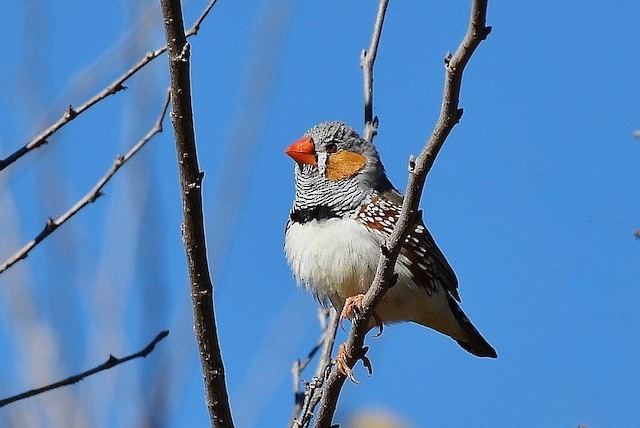
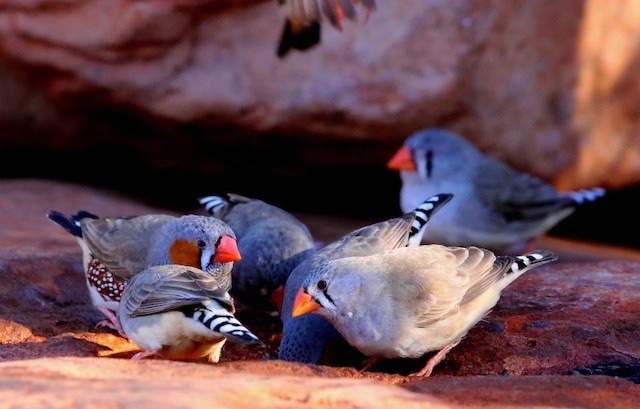
the zebra finch is a small passerine bird native to central australia and indonesia. the finches are very social, and live in large colonies. their diet consists mainly of grass seeds; they breed based on availability of water, as they feed their young ripening seeds, not dried seeds.




 today's bird